
Asphalt Driveway Cost in Georgia (2026)
Stoutwell Paving · October 10, 2026 · 8 min read
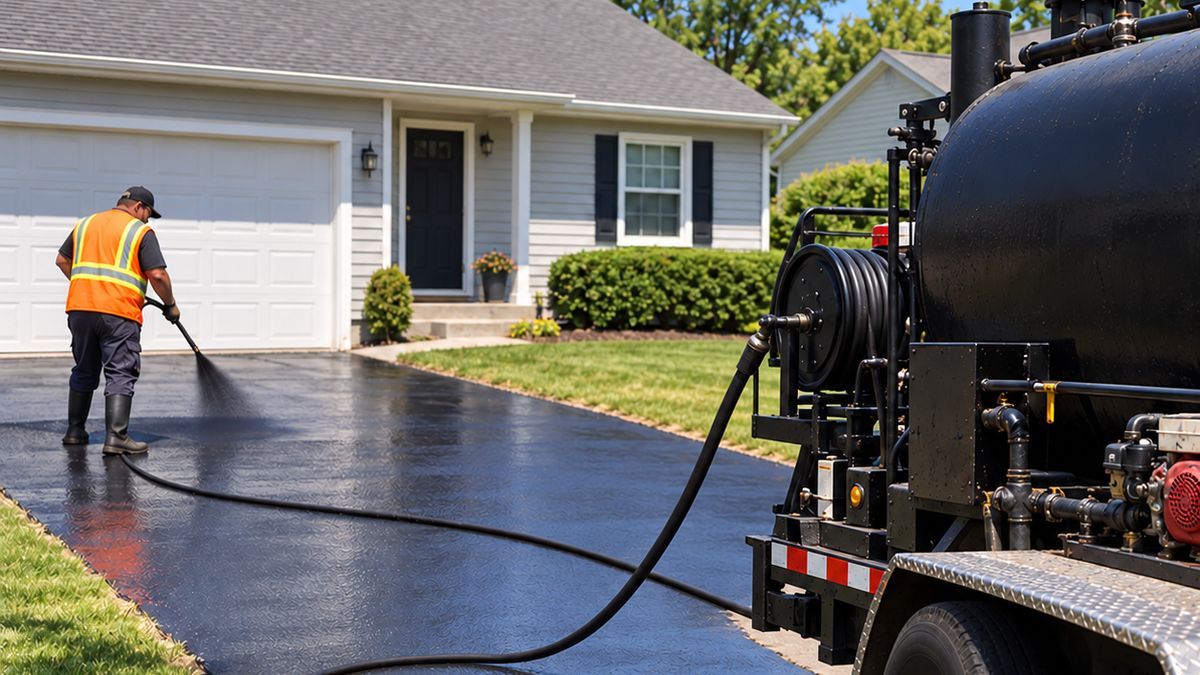
A new asphalt driveway in Georgia typically costs $7 to $13 per square foot installed, and an overlay of a sound driveway $3 to $7. Georgia splits at the Fall Line, and so does the price: sticky red clay above the Fall Line, loose sand or wet flats below it. Your own number comes from a free written quote.
At a glance:
- From Atlanta to Savannah, a new 12 by 50 foot two-car driveway runs $4,200 to $7,800.
- North of the Fall Line (Columbus, Macon, Milledgeville, Augusta), the subsoil is mostly red clay; south of it, sand.
- Macon averages 85.4 days a year at 90°F or hotter, against 7.6 at Blairsville in the mountains.
- Blairsville’s frost-free paving window is 176 days; Savannah’s is 270.
- Any driveway work in a state highway right-of-way needs a GDOT permit first.
What Does an Asphalt Driveway Cost in Georgia?
Ranges are per square foot; one row prices the common 600 square foot driveway, and the last column is what the job tends to be on Georgia clay or sand.
| Job | Typical price | What it usually involves on a Georgia lot |
|---|---|---|
| New asphalt driveway | $7 to $13 per square foot | Stripping topsoil, shaping the clay or sand subgrade, a compacted stone base, then hot asphalt |
| Two-car driveway, 12 by 50 feet, 600 sq ft, new | $4,200 to $7,800 | Nearer the top on wet Piedmont clay, nearer the bottom on drained Sandhills sand |
| Overlay of an existing driveway | $3 to $7 per square foot | Only where the old driveway still sheds water and the base has not pumped up clay |
| Driveway sealcoating | $0.88 to $2.10 per square foot | Cleaning, crack filling and a sealer coat, timed around summer heat and afternoon storms |
| Removing an old driveway | $2 to $4 per square foot | Breaking out and hauling the old surface before the subgrade is reworked |
Clay to cut or dry out, water to carry off a flat coastal lot, and a GDOT permit at the road are what move a Georgia job inside its range. The asphalt driveway cost guide shows what each range includes.
What Changes the Price of a Driveway in Georgia
Red clay that turns to grease when wet. Across the Piedmont, including metro Atlanta, a typical upland soil is Cecil. The USDA’s official description puts red clay from about 8 to 42 inches down, firm when dry, sticky and plastic when wet, with flakes of mica through it. Clay like that is hard to compact while it is soaked, and it can push up into stone that was laid on it wet. It may need grading to shed water and a stone base thick enough to bridge it, and those two lines can put a Piedmont driveway above the same footprint on sand.
Sand below the Fall Line. The Fall Line runs northeast across the state from Columbus through Macon and Milledgeville to Augusta, and south of it sandy soils take over. In the Sandhills and on the upper Coastal Plain, soils like Lakeland are excessively drained, so standing water is less often the problem. The work there is usually compaction: sand that drains this freely can still shift under a truck tire unless it is rolled tight first.
Groundwater at the surface on the coastal flats. On the broad flats around Statesboro and Savannah, soils like Pelham are poorly drained, and groundwater can stand anywhere from a foot above the surface to a foot and a half below it. Asphalt laid on saturated ground can fail from underneath. Around Savannah and Statesboro, the grade may need raising with fill before the stone goes down; sealer cannot fix water that has nowhere to go.
Heat in Middle and South Georgia. NOAA’s 1991 to 2020 normals count 85.4 days a year at 90°F or hotter at Macon, 80.5 at Savannah and 79.9 at Brooklet, just outside Statesboro. A Middle Georgia driveway paved in July may need a few extra days before cars go on it, and a tight turn can mark it through its first summer.
A state route at the end of the driveway. GDOT’s Regulations for Driveway and Encroachment Control require a permit before any construction in a state highway right-of-way, and widening or relocating an existing driveway there needs one too. Where a roadside ditch crosses the entrance, GDOT calls for a driveway pipe designed for a 25 year storm, and that pipe is a line of its own.
Paving Across Georgia: Mountains, Piedmont and Coast
- The north Georgia mountains. Blairsville averages 104.1 nights a year at or below 32°F and a frost-free stretch of 176 days, from about 26 April to 19 October. Clayton, in Rabun County, records 71.73 inches of rain a year and 23 days with an inch or more. Book a mountain driveway for late spring or summer, and ask how much of the quote is drainage.
- Metro Atlanta and the Piedmont. We pave and seal across Fulton, DeKalb, Cobb, Gwinnett and Clayton counties; see asphalt paving in Atlanta. Atlanta’s airport averages 50.43 inches of rain a year and a 252 day frost-free stretch: a long season, but rained-on clay needs dry days before it can be compacted.
- Middle Georgia and the Fall Line. Around Macon, in Bibb, Crawford, Jones, Monroe and Twiggs counties, clay and sand can meet on a single lot. See Macon asphalt paving.
- The coast and the Coastal Plain. Savannah’s frost-free stretch runs 270 days and its snowfall normal is zero, so rain and groundwater set the schedule, not frost. We serve Chatham, Effingham and Bryan counties from the Savannah area page, and Bulloch, Candler, Evans and Screven counties from Statesboro. Inside Savannah city limits, a curb cut for a driveway needs a city permit, with a $75 residential fee.
GDOT’s own road rules are a fair standard for a driveway in any of these regions: no asphalt on a wet or frozen surface, and at least 45°F in the air for a mat 1.1 to 2 inches thick (55°F for one inch or less). For month-by-month timing, see the best time to pave.
What to Check Before You Hire a Paver in Georgia
The State Licensing Board for Residential and General Contractors licenses Georgia’s residential and general contractors. The Board does not say whether a driveway alone needs one. Look up any license number you are given on the Secretary of State’s verification site. The board decides what applies to your project. The Board’s own advice to homeowners is plain:
- Get a written contract that spells out the work, the materials, the clean-up, a completion date and a payment schedule.
- Never pay the whole cost before the work is done.
- Be wary of a contractor who asks you to pull the permit in your own name; whoever holds the permit carries the responsibility for it.
On a Georgia lot, also pin down:
- How the red clay or sand will be prepared, how thick the compacted stone base will be, and where the water goes.
- Whether pumped-up clay means the old base is finished; overlay versus replacement helps you decide.
- Who applies for any GDOT, city or county permit, and whether the fee is in the price.
Frequently Asked Questions
How much does an asphalt driveway cost in Georgia?
A new asphalt driveway typically costs $7 to $13 per square foot installed, so a 12 by 50 foot two-car driveway comes to $4,200 to $7,800. Overlaying a sound one runs $3 to $7 per square foot. Red clay or a wet coastal lot can push a Georgia job toward the top; your own number comes from a free written quote.
Is red clay bad for an asphalt driveway?
Not if it is handled before the stone goes down. Piedmont clay is firm when dry but sticky and plastic when wet, so it may need grading to shed water, compaction at the right moisture and a proper stone base on top. A quote that skips the subgrade on red clay is pricing the asphalt, not the driveway.
Can you pave a driveway in Georgia in winter?
Often, in Middle and South Georgia, where the frost-free stretch runs 235 days at Macon and 270 at Savannah. In the mountains it is harder: Blairsville averages 104.1 nights a year at or below freezing. GDOT will not let asphalt go down on a wet or frozen surface on state roads, and that is a fair bar for a driveway too.
Do I need a permit for a driveway onto a state highway in Georgia?
Yes. GDOT requires a permit before any construction in the state highway right-of-way, including widening or moving an existing driveway. Residential applications come from the GDOT Area Office, and the Department aims to decide within 20 working days once it has everything it needs.
Get an Asphalt Driveway Quote in Georgia
We grade, pave and seal asphalt driveways in metro Atlanta, Middle Georgia, Savannah and the Statesboro area. To price yours, we need:
- The city or ZIP code, so we know which of those areas you are in.
- Length and width, even rough.
- Photos showing red clay at the edges, soft spots, cracks, and where water stands after an afternoon storm.
- Whether a ditch crosses the entrance or the drive meets a GDOT route.
- New paving, an overlay, sealcoating or a tear-out.
Use the quote button on this page and we will come back with a written number.
Ready for a Price on Your Property?
Guides give general ranges. Your free quote covers your own lot or driveway.
 Cost Guides
Augusta, GA Parking Lot Repair
Our Augusta parking lot crack filling runs $0.65 to $2.25 per linear foot and patching $2 to $12 per sq ft. See how clay, sand and summer storms wear a lot.
 Cost Guides
Asphalt Sealcoating Cost in Savannah, GA
What sealcoating a driveway costs in Savannah, GA: the typical per-square-foot range, how summer rain and heat shape the schedule, and the $75 city permit.
Cost Guides Sealcoating Cost in Statesboro, GA
Statesboro, GA driveway sealcoating cost: the typical $0.88 to $2.10 per square foot range, plus local rain, heat and wet soil that can move a quote.
Ready for a Free Quote?
Get a free, no-obligation quote for your Georgia driveway.
Get Your Free QuoteOr call us directly: (919) 219-2946
Final scope, schedule, and pricing are confirmed after an on-site inspection and documented in the written project agreement.
Get a free quote for your lot
We seal, stripe and repair lots for churches, schools and shopping centers.