
How Often to Sealcoat a Parking Lot
Stoutwell Paving · November 15, 2026 · 8 min read
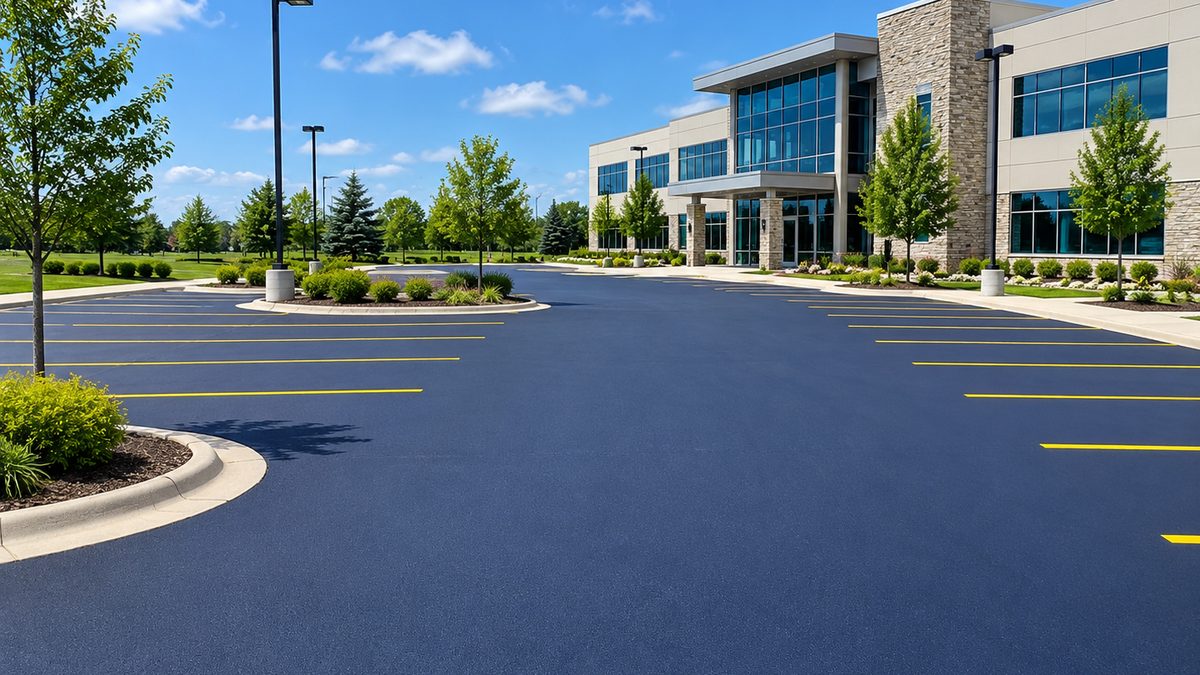
Seal a parking lot when its surface says so, not when a date comes round. The signs are plain: the black has faded to gray, the pavement feels rough underfoot, small stones are working loose, or fine cracks have started to spread across the drive lanes. On most lots that comes every few years, sooner under heavy traffic, strong sun or a long plowing season. Our sealcoating runs $0.15 to $0.30 per square foot, and your own number comes from a free written quote.
Below is how to read a lot for sealing, why we do not hand out a fixed schedule, and what it costs to seal too early or too late. If you look after a church, a school, a business or a managed property, this is how to tell whether this is the year.
How do you know a parking lot is due for sealing?
Walk the lot on a dry day, in the middle of the morning when the light is flat. You are looking for five things.
- Color. Fresh sealer is deep black. As it wears, the lot fades to brown and then to gray, first in the lanes and last in the corners.
- Texture. A sealed surface feels tight and smooth. A worn one feels like coarse sandpaper, because the fine material between the stones has started to wash away.
- Loose stone. Small gravel collecting along curbs, in gutters or by the drains means the surface is giving up its top layer.
- Hairline cracks. Thin cracks running across the lanes, or a fine web of them near the entrance, mean water now has a way in.
- How water behaves. After rain, a sealed lot sheds water and dries evenly. A worn lot darkens in patches and stays damp longer, because water is soaking into the surface.
One or two of these in a few spots is a lot that is getting close. Most of them across the main lanes is a lot that is due.
Why we do not set a number of years
Two lots paved the same week can need sealing years apart. What wears a seal away is the life the lot lives, and that differs from one property to the next.
Traffic. A grocery store lot with a drive-through and daily deliveries scrubs sealer off far faster than a church lot that fills one morning a week. Turning tires do the most damage, so entrances and the main drive lane wear first.
Sun. Sunlight dries out asphalt and breaks down the binder that holds the stones together. A lot with no shade in a hot climate fades faster than one shaded by a building or trees.
Water and drainage. A lot that drains well stays dry underneath. A lot with low spots, blocked drains or water running across it from a roof or a slope gets wet more often, and wet asphalt ages faster.
Plows and salt. A long plowing season scrapes the surface, and freeze and thaw cycles work on every crack. Northern lots often need attention sooner than southern ones for this reason alone.
What came before. A lot that has been sealed on time and had its cracks filled holds up longer than one that was left to dry out first.
So we look at the lot and tell you whether it needs sealing now, next season, or not yet. That answer goes on the quote.
Reading your lot: what we suggest
| What you see | What it usually means | What we suggest |
|---|---|---|
| Deep black, smooth, no cracks | The coat is still working | Wait, and look again next season |
| Faded lanes, black corners | Traffic is wearing the coat | Plan a reseal soon, with extra coverage on the lanes |
| Gray and rough across most of the lot | The coat is spent | Seal this season, after a sweep and crack filling |
| Hairline cracks spreading | Water is getting in | Fill the cracks, then seal |
| Potholes, ruts or soft spots | The damage is below the surface | Repair first; sealing alone will not fix it |
What sealing too often costs
Sealing a lot that does not need it is money spent early, but it can also do harm. Each coat of sealer adds a thin layer. Laid over a coat that is still in good shape, the layers build up into a skin that is thicker than the sealer was meant to be. A thick skin can crack and peel in its own pattern, and it can turn slick in wet weather.
So a lot that is still black and tight should be left alone, even if the building next door is being sealed, even if the budget has the money in it. The better use of that money is often crack filling on the spots that need it, at our $0.65 to $2.25 per linear foot.
What waiting too long costs
Waiting has a different cost. Sealer protects pavement that is still sound; it cannot fix pavement that has already broken. Once the surface is open, water gets under it, and each freeze pushes the cracks wider. A lot that could have been sealed for a few cents a square foot ends up needing patching at $2 to $12 per square foot first, and in the worst areas, more than patching.
The gap between those two prices is the reason to seal on time. The coat is the cheap part of keeping a lot. The repairs it holds off are not.
The first seal on a new or rebuilt lot
New asphalt needs to cure before it is sealed. Sealer laid on fresh pavement traps oils that are still working their way out, and the coat will not bond well. We wait at least 30 to 60 days after paving, and many owners give a new lot its first coat in its first or second full season.
After that, the lot goes on the same footing as any other: we read the surface and seal when it shows wear.
Where a lot wears first
Sealer does not wear evenly. The places that fade first are the places where tires turn, stop and start:
- The entrances and exits, where every car turns.
- The main drive lanes, where traffic runs all day.
- Drive-throughs, pickup lines and bus loops, where cars sit and creep.
- Dumpster pads and loading areas, where trucks stop and turn hard.
That is why we apply two coats over the lot and a third on the entrances, exits and drive lanes. It is also why a lot can look worn at the front while the back rows still look fine. We judge the lot by the areas that carry the traffic.
Budgeting for the next reseal
Sealing is priced by the square foot, and line painting follows every seal, because sealer covers the lines. As arithmetic only, a lot of 20,000 square feet with 60 stalls comes to $3,000 to $6,000 to seal at our rate and $240 to $300 to restripe at $4 to $5 per stall. Accessible stalls and symbols are $25 to $100 each, and crack filling is its own line.
For a board or an owner, it helps to know which year the lot is likely to be due, even though the surface sets the exact timing. When we walk your lot, we tell you whether it is due now or how many seasons it looks to have left, so the money can be set aside ahead of time.
Frequently Asked Questions
How often do you need to sealcoat a parking lot?
When the surface asks for it: the black has faded to gray, the pavement feels rough, small stones are coming loose or fine cracks are spreading across the lanes. On most lots that comes every few years, sooner under heavy traffic, strong sun or a long plowing season.
Can you sealcoat a parking lot too often?
Yes. Sealer laid over a coat that is still doing its job builds up into a thick skin that can crack, peel and turn slick. If your lot is still black and tight, we tell you to wait.
How long does parking lot sealcoating last?
It wears fastest where tires turn and stop, at entrances, drive lanes and drive-throughs, and slowest in the back rows. The lot itself tells you when the coat is spent, which is why we read the surface instead of counting years.
How soon can a new parking lot be sealcoated?
New asphalt needs time to cure before its first coat, so we wait at least 30 to 60 days after paving. Many owners seal a new lot for the first time in its first or second full season.
Does a parking lot need restriping after every sealcoat?
Yes. Sealer covers every line on the lot, so line painting follows each seal. Our restriping runs $4 to $5 per stall over the existing layout.
What is the best time of year to reseal a parking lot?
Any stretch of warm, dry days with no rain expected for a day after. Where winters are cold that means spring into fall, and lots due for sealing are best booked early in the season.
Find out whether your lot is due
The answer to how often is the answer for your own lot, and we give it after we have seen the pavement. A free written quote says whether to seal now or wait, and prices the sealing, the crack filling and the restripe on their own lines. The parking lot sealcoating cost guide shows how a lot is measured, the sealcoating and striping order guide shows how the job runs, and our sealcoating vs resurfacing guide covers a lot that is past sealing. What the sealing itself involves is on our parking lot sealcoating service page, with every rate side by side on the pricing page.
Ready for a Price on Your Property?
Guides give general ranges. Your free quote covers your own lot or driveway.
 Guides
ADA Parking Requirements: Stall Counts, Sizes and Signs
ADA parking requirements: how many accessible spaces a lot needs, their sizes, signs and aisles. We mark each ADA stall or symbol for $25 to $100. Request a free quote.
Guides Parking Lot Line Painting and Stenciling
What parking lot line painting covers: stall lines, arrows, stencils, colors and paint vs thermoplastic. We repaint lines for $4 to $5 per stall. Request a free quote.
 Guides
Parking Space Dimensions: Stall Width, Length and Aisles
Standard parking space size, stall width, aisle width and accessible spaces, with real city rules. We lay out new stalls for $0.50 to $1.20 per linear foot.
Ready for a Free Quote?
Get a free, no-obligation quote for your property.
Get Your Free QuoteOr call us directly: (919) 219-2946
Final scope, schedule, and pricing are confirmed after an on-site inspection and documented in the written project agreement.
Get a free quote for your lot
We seal, stripe and repair lots for churches, schools and shopping centers.