
ADA Parking Requirements: Stall Counts, Sizes and Signs
Stoutwell Paving · November 15, 2026 · 9 min read
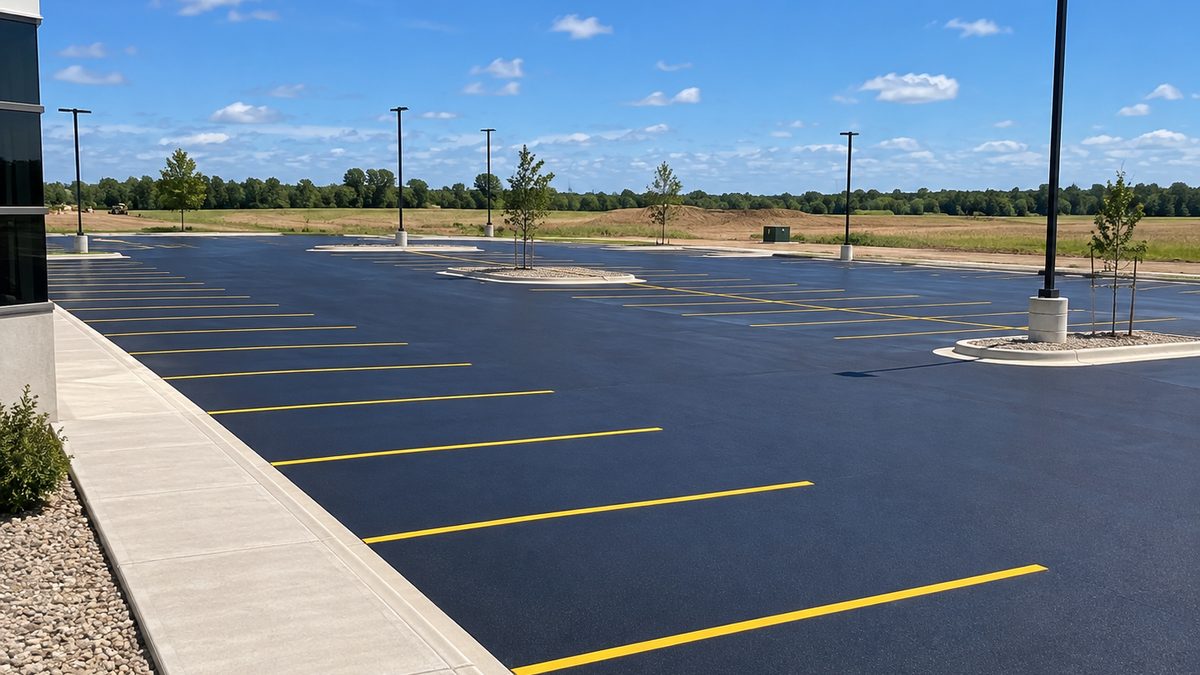
A parking lot needs accessible spaces in step with its size: 1 for a lot of up to 25 spaces, 2 for 26 to 50, 3 for 51 to 75 and 4 for 76 to 100, with the count rising from there. At least one in every six accessible spaces must be wide enough for a van. We mark each accessible stall or symbol for $25 to $100, on top of $4 to $5 per stall for restriping the rest of the lot, and your own number comes from a free written quote.
Below, in plain words, is what the federal rules ask a lot to have: the count, the sizes, the signs and where the spaces go, and what we paint to meet them. Your local building office has the final word on your own lot.
How many accessible parking spaces does a lot need?
The count goes by the total number of spaces in each parking lot or garage on the property, not by the building’s size.
| Total spaces in the lot | Accessible spaces needed |
|---|---|
| 1 to 25 | 1 |
| 26 to 50 | 2 |
| 51 to 75 | 3 |
| 76 to 100 | 4 |
| 101 to 150 | 5 |
| 151 to 200 | 6 |
| 201 to 300 | 7 |
| 301 to 400 | 8 |
| 401 to 500 | 9 |
| 501 to 1,000 | 2 percent of the total |
| Over 1,000 | 20, plus 1 for each 100 over 1,000 |
Two details catch owners out. A property with two separate lots counts each one on its own, so a front lot of 30 and a rear lot of 30 need two accessible spaces each, four in all, where one lot of 60 would need three. And lots that serve hospital outpatients need at least 10 percent of their spaces accessible, and lots serving rehabilitation or outpatient physical therapy patients at least 20 percent.
What makes a space van accessible?
One in every six accessible spaces, or part of six, must be van accessible. A lot that needs one to six accessible spaces needs at least one van space; a lot that needs seven needs two.
A van space is wider so a side lift or ramp has room to deploy. There are two ways to lay it out:
- An 11 foot space with a 5 foot access aisle, or
- An 8 foot space with an 8 foot access aisle.
A standard accessible car space is at least 8 feet wide with an aisle at least 5 feet wide. Two accessible spaces can share one aisle between them, which saves room on a tight lot. In a parking garage, van spaces and the route to them also need enough height for a raised roof van.
What we paint on an accessible stall
An accessible space is more than a blue symbol. On a typical stall we paint:
- The stall lines, set to the wider width the space needs.
- The access aisle, the striped area beside the stall where a wheelchair user gets in and out. It runs the full length of the stall and is hatched with diagonal lines so nobody parks in it.
- The symbol of accessibility on the pavement, where the layout calls for one.
- Van accessible wording or markings on the van spaces, where the layout calls for them.
The federal rules ask for a marked space, a marked aisle and a sign. They do not set a paint color or require the symbol on the pavement. Many states and towns go further, with blue paint, a painted symbol or “no parking” wording in the aisle. We mark each stall the way the layout for your lot calls for.
The upright sign at the head of each accessible space is part of the rule too. It carries the symbol of accessibility, reads “van accessible” on the van spaces, and is mounted with its bottom edge at least 5 feet above the ground so a parked car does not hide it. Our striping price covers what is painted on the pavement; if a sign is missing or worn, we note it on the quote so it is not missed.
Where the accessible spaces go
Location matters as much as count. Accessible spaces belong on the shortest accessible route to an accessible entrance, so the person parking has the least distance to travel and does not have to cross behind rows of parked cars where that can be avoided. A building with several accessible entrances spreads its accessible spaces among them.
The ground under the stall and the aisle has to be nearly level, about a 2 percent slope at most in any direction. That is a fact about the pavement, not the paint, and it is one reason accessible stalls are not simply painted wherever there is room. If the flattest spot near the door is where the stalls already are, the restripe keeps them there.
The access aisle must connect to the accessible route without a curb in the way, and it cannot overlap the drive lane. A curb ramp can serve the aisle, but it cannot sit inside the aisle itself.
Does restriping a lot trigger the ADA count?
Often, yes. When a whole lot is restriped, or sealed and then restriped, the new layout is the moment to bring the accessible spaces up to the count for the lot’s size. A lot that had two accessible spaces when it was built but now holds 120 cars should come out of a restripe with five.
Touching up a few faded lines in place is different; that is ordinary upkeep. The line between the two is not always obvious, which is why we look at the accessible spaces on every striping quote and tell you what we see: how many there are, how many the lot’s size calls for, and whether a van space is among them.
Changing the layout, such as moving stalls or adding rows, always brings the count into play. Our new layout runs $0.50 to $1.20 per linear foot, and the accessible spaces are planned into it from the start.
What accessible striping costs
We price accessible parking on its own lines, so you can see it apart from the rest of the lot:
- Accessible stall or symbol: $25 to $100 each, with the access aisle listed alongside.
- Standard stalls: $4 to $5 each to restripe over the existing layout.
- New layout: $0.50 to $1.20 per linear foot when stalls move.
- Striping minimum: $150 to $350 per job, for a small lot or a short list.
As arithmetic only, a lot of 150 spaces needs five accessible spaces, one of them van accessible. Marking the five comes to $125 to $500, and restriping the other 145 stalls comes to $580 to $725. A small lot that needs only its single accessible stall freshened meets the minimum instead.
Churches, private clubs and small lots
Places of worship are largely outside the federal rules for public accommodations, and so are private clubs. That is not the same as having no rules. State and local building codes can still call for accessible parking, and a school, day care or other group renting the building may be covered on its own. A congregation with members who use wheelchairs or walkers also has a plain practical reason to keep accessible stalls clearly marked.
Very small lots have one exception: a lot with four or fewer spaces in total does not need the sign at its accessible space, though it still needs the space itself, and that space must be van accessible.
Who decides what your lot needs
Federal rules set the floor. State codes, town codes and the permit your building was approved under can add to it, and your local building office is the place to ask when a layout is changing. Our state guides set out what five states add: Texas, North Carolina, Georgia, Tennessee and Alabama. Stall and aisle sizes for the rest of the lot are in our parking space dimensions guide. We paint the layout that applies to your lot, and we tell you at the quote stage if the accessible count or a van space looks short.
Frequently Asked Questions
How many handicap parking spaces are required in a parking lot?
It goes by the size of the lot: 1 accessible space for up to 25 spaces, 2 for 26 to 50, 3 for 51 to 75 and 4 for 76 to 100, rising from there. At least one in every six accessible spaces must be van accessible.
How wide is an ADA parking space?
A car space is at least 8 feet wide with an access aisle at least 5 feet wide beside it. A van space is either 11 feet wide with a 5 foot aisle, or 8 feet wide with an 8 foot aisle.
Do handicap parking spaces have to be painted blue?
The federal rules ask for a marked space, a marked aisle and a sign, not a particular paint color. Many states and towns do require blue paint or a painted symbol, and we mark the stall the way the layout for your lot calls for.
How much does it cost to stripe a handicap parking space?
We mark each accessible stall or symbol for $25 to $100, with the access aisle listed alongside it. That is on top of $4 to $5 per standard stall for the rest of the lot.
Does restriping a parking lot require ADA upgrades?
Restriping a whole lot is the point where the accessible spaces should be brought up to the count the lot’s size calls for, even if the old layout had fewer. Touching up a few faded lines in place is ordinary upkeep.
Do churches need ADA parking spaces?
Places of worship are largely outside the federal public accommodation rules, but state and local building codes can still require accessible parking, and a school or day care renting the building may be covered. Your local building office has the answer for your lot.
Get the accessible spaces right on your next restripe
A free written quote counts your stalls, checks the accessible spaces against the lot’s size and prices every marking on its own line. The parking lot striping cost guide covers the rest of the markings, the sealcoating and striping order guide shows where the line painting falls in a reseal, and how often to sealcoat a parking lot helps you time the next one. Our parking lot striping service page covers the full line painting job, and the pricing page sets the accessible stall price beside the rest.
Ready for a Price on Your Property?
Guides give general ranges. Your free quote covers your own lot or driveway.
 Guides
How Often to Sealcoat a Parking Lot
Reseal a parking lot when the surface turns gray, rough or cracked, not on a calendar. Our sealing runs $0.15 to $0.30 per sq ft. Request a free quote.
Guides Parking Lot Line Painting and Stenciling
What parking lot line painting covers: stall lines, arrows, stencils, colors and paint vs thermoplastic. We repaint lines for $4 to $5 per stall. Request a free quote.
 Guides
Parking Space Dimensions: Stall Width, Length and Aisles
Standard parking space size, stall width, aisle width and accessible spaces, with real city rules. We lay out new stalls for $0.50 to $1.20 per linear foot.
Ready for a Free Quote?
Get a free, no-obligation quote for your property.
Get Your Free QuoteOr call us directly: (919) 219-2946
Final scope, schedule, and pricing are confirmed after an on-site inspection and documented in the written project agreement.
Get a free quote for your lot
We seal, stripe and repair lots for churches, schools and shopping centers.