
Asphalt Driveway Cost in Kentucky (2026)
Stoutwell Paving · October 10, 2026 · 8 min read
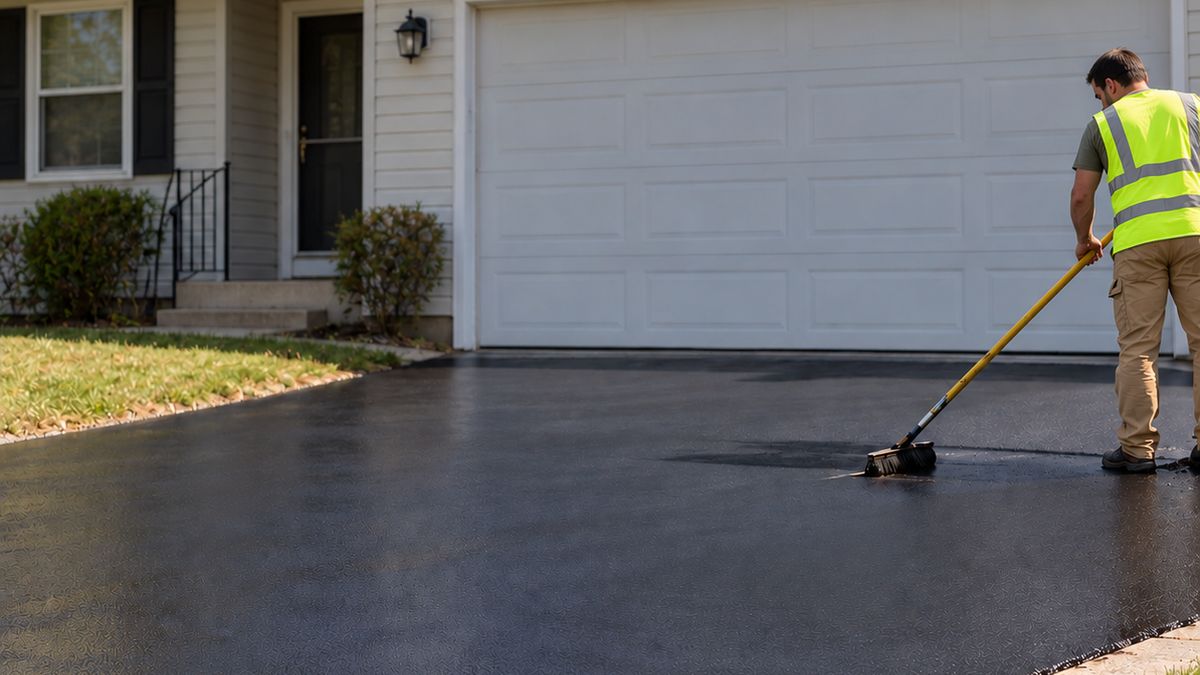
A new asphalt driveway in Kentucky typically costs $7 to $13 per square foot installed. What moves a Kentucky driveway inside that range is mostly underground: limestone that dissolves into sinkholes under much of the state, clay-rich slope soil on the northern and eastern hills, and how many freezing nights your county gets. Your own number comes from a free written quote.
At a glance:
- A two-car driveway, 12 by 50 feet (600 square feet), works out to $4,200 to $7,800 new.
- The Kentucky Geological Survey puts 55 percent of the state on rock prone to karst, the ground that forms sinkholes.
- Northern Kentucky’s airport in Boone County averages 99.8 nights a year at or below freezing; Louisville averages 74.
- A new entrance onto any state highway needs a Kentucky Transportation Cabinet encroachment permit.
- Paving is not on the state licensing department’s list of trades, so ask your city or county what applies.
What Does an Asphalt Driveway Cost in Kentucky?
| Job | Typical price | Where it fits on a Kentucky lot |
|---|---|---|
| New asphalt driveway | $7 to $13 per square foot | Topsoil out, any sinkhole fill or loose slope soil dug out, compacted stone, then hot mix |
| Two-car driveway, 12 by 50 feet, 600 sq ft, new | $4,200 to $7,800 | A run from the garage, plus sinkhole or slope work if the lot needs it |
| Overlay of an existing driveway | $3 to $7 per square foot | Only where the old surface has not dropped over a sinkhole or crept downhill |
| Driveway sealcoating | $0.88 to $2.10 per square foot | A dry, warm day between mid spring and mid fall, on asphalt that has cured |
| Removing an old driveway | $2 to $4 per square foot | Tearing out a surface that has sunk or crept downhill so the base can be rebuilt |
Where your job lands inside a range comes down to how much digging and stone the subgrade needs, how runoff will leave the drive, the slope, and the month we can pave. The asphalt driveway cost guide breaks down what each range includes.
What Makes a Kentucky Driveway Cost More or Less
Sinkholes and karst. The Kentucky Geological Survey estimates that 55 percent of Kentucky sits above rock prone to karst, where limestone dissolves and the surface can sink or collapse, and it lists Louisville, Lexington, Frankfort, Bowling Green, Elizabethtown, Hopkinsville, Georgetown, Nicholasville and Somerset among the cities partly or wholly on it. The survey also warns that fill placed in a sinkhole can be carried away underground until the soil above gives way. Before we price a lot in that country, we ask about old depressions and look for them in your photos of the yard. Digging out soft fill and rebuilding with compacted stone, or moving the drive’s line, may add excavation and base to the quote.
Hillside soil in the north and east. On the hills south of the Ohio River, the survey’s landslide brochure describes colluvium, a clay-rich soil that coats many slopes and “easily fails if disturbed,” and names cuts, fills and runoff from new roads and paved surfaces as leading causes of slope failure. Its advice is to set construction, driveways included, back from the brow of a slope. A drive cut into a hillside in Kenton or Campbell County, or up a hollow in eastern Kentucky, can need old fill removed, the base benched and compacted, and a ditch or culvert to carry water off. Those lines can be the difference between the bottom and the top of the range.
Freeze and thaw, north to south. NOAA’s 1991 to 2020 normals count 99.8 nights at or below 32°F at the Cincinnati/Northern Kentucky airport, 89.9 at Lexington, 82.8 at Paducah and 74.0 at Louisville. Those air temperature counts describe a colder season in the north, so drives in the Bluegrass and the north may benefit from a thicker base and cracks sealed before November.
Rain days in the mountains. Jackson, in Breathitt County, averages 51.89 inches of precipitation and 94.8 days a year with at least a tenth of an inch. A base has to drain and dry before hot mix goes on, so eastern jobs can carry more drainage work and more chance of a moved paving date.
Summer heat in the west and the cities. Paducah logs 50.2 days a year at or above 90°F and Bowling Green 47.4. In those towns a midsummer job is often booked for the morning, and the car may need to stay in the street a little longer before it parks on the new surface.
Paving Season Across Kentucky
The Kentucky Transportation Cabinet’s own highway specification is a useful yardstick. It does not allow hot mix on a wet surface, wants at least 45°F of air and surface temperature for a surface course an inch thick or less, and between 30 November and 1 April it holds permanent asphalt work for written approval. We hold driveways to the same sense. NOAA’s median dates for the last spring freeze and the first fall freeze show how the window shifts:
- Louisville. 31 March to 7 November, 222 days. May is the wettest month at 5.18 inches.
- Western Kentucky. Paducah runs 5 April to 28 October, 206 days, and Bowling Green 5 April to 31 October, 208 days. April is Paducah’s wettest month.
- The Bluegrass. Lexington runs 13 April to 28 October, 196 days, with May its wettest month at 5.44 inches.
- Eastern Kentucky. Jackson runs 6 April to 1 November and London 15 April to 25 October; both are wet in late spring and early summer.
- Northern Kentucky. The Boone County airport runs 18 April to 25 October, only 188 days, with 23.3 inches of snow a year. Book early in the season.
If your date falls in late October in northern Kentucky, or before April anywhere, ask what moves the job when the morning comes in under 45°F or the base is wet. Our best time to pave a driveway page goes deeper on timing.
What to Check Before You Hire a Paver in Kentucky
Paving is not on the state’s licensing list. Kentucky’s Department of Housing, Buildings and Construction licenses plumbers, electricians, boiler, sprinkler and fire alarm contractors and building inspectors; paving is not on that list. Local rules decide the rest. Lexington-Fayette’s Contractors Registration Ordinance requires every contractor to register with Building Inspection, and unregistered contractors cannot pull building permits there. So before you sign:
- Ask your city or county whether driveway contractors must register or hold a local license, and check the name on the quote against it.
- If the drive meets a state highway, ask who will apply for the KYTC encroachment permit at the district office, and make sure the timing is in the schedule.
- Get a written scope with the square footage, the stone base and its compacted depth, the asphalt thickness, and where water will go. Runoff aimed at a sinkhole or over the brow of a slope is a warning sign.
- If the lot is on karst or a hillside, ask what was checked for, and get in writing what happens if soft ground turns up during the dig.
Frequently Asked Questions
How much does an asphalt driveway cost in Kentucky?
A new asphalt driveway typically runs $7 to $13 per square foot installed, which puts a 12 by 50 foot, two-car driveway at $4,200 to $7,800. An overlay on a sound old surface runs $3 to $7 per square foot. Sinkhole fill, hillside soil and drainage work push a Kentucky quote up; a free written quote gives your own number.
Do I need a permit to connect my driveway to a Kentucky state highway?
Yes. Kentucky law (KRS 177.106) requires a permit for any encroachment on a state highway right-of-way, and a new entrance counts. Applications go through the Kentucky Transportation Cabinet’s twelve highway district offices. On a city street or county road, ask the city or county before the apron is cut.
Is there a state license for driveway pavers in Kentucky?
Not on the state’s list. The Department of Housing, Buildings and Construction licenses trades such as plumbing and electrical work, and paving is not among them. Some local governments have their own rules: Lexington-Fayette requires every contractor to register with Building Inspection. Ask your city or county what applies and check any registration against it.
Is a sinkhole near my driveway a problem for new asphalt?
It can be. The Kentucky Geological Survey warns that fill placed in a sinkhole can wash out underground and let the ground above collapse. Before paving, locate the old depression; it may need to be dug out and rebuilt or avoided, and roof and driveway runoff should not be aimed into it.
Get an Asphalt Driveway Quote in Kentucky
Sinkholes and slopes are easiest to price from good photos. We pave and seal residential driveways; to price a Kentucky job, send us:
- Your city or ZIP code.
- The driveway’s rough length and width, and whether it climbs or drops.
- Photos of the current surface, cracks, sunken spots and any depressions in the yard nearby.
- Whether the drive opens onto a state highway, a city street or a county road.
- What you want: new paving, an overlay, sealcoating, or tear-out and replacement.
Request a free written quote and note that the driveway is in Kentucky.
Ready for a Price on Your Property?
Guides give general ranges. Your free quote covers your own lot or driveway.
 Guides
Lexington, KY Parking Lot Upkeep and Cost
We seal Lexington lots for $0.15 to $0.30 per sq ft and restripe for $4 to $5 per stall. How often a lot needs each depends on its wear. Request a free quote.
 Guides
Louisville, KY Parking Lot Upkeep and Cost
We seal Louisville lots for $0.15 to $0.30 per sq ft and restripe for $4 to $5 per stall. See how often a lot needs both, then request a free quote.
 Cost Guides
Asphalt Parking Lot Repair Cost: Cracks and Potholes
Our parking lot crack filling runs $0.65 to $2.25 per linear foot and patching $2 to $12 per sq ft. See what moves each rate, then request a free quote.
Ready for a Free Quote?
Get a free, no-obligation quote for your Kentucky driveway.
Get Your Free QuoteOr call us directly: (919) 219-2946
Final scope, schedule, and pricing are confirmed after an on-site inspection and documented in the written project agreement.
Get a free quote for your lot
We seal, stripe and repair lots for churches, schools and shopping centers.